

The Traffic Injury Research Foundation (TIRF) undertook a research project to understand the effectiveness of posted speed limit reductions in partnership with SMATS Traffic Solutions. This project was funded through Transport Canada’s Enhanced Road Safety Transfer Payment Program (ERSTPP). As cities increasingly adopt lower speed limits to enhance road safety, this research offers critical insights into where these changes are most effective and how roadway design influences driver compliance.
The study is utilizing high-resolution big data from connected vehicles, including speeds, harsh braking and acceleration. By integrating these datasets, the project is observing changes in speeding behaviours before and after the lowering of speed limits and developing:
- Predictive Speed Models: Quantifying the expected reduction in average and 85th percentile speeds based on initial conditions.
- Infrastructure Analysis: Identifying specific roadway features, such as lane width and the presence of medians, that act as barriers to effective speed management.
- Safety Performance Functions: Utilizing surrogate safety measures to identify high-risk hotspots before crashes occur.
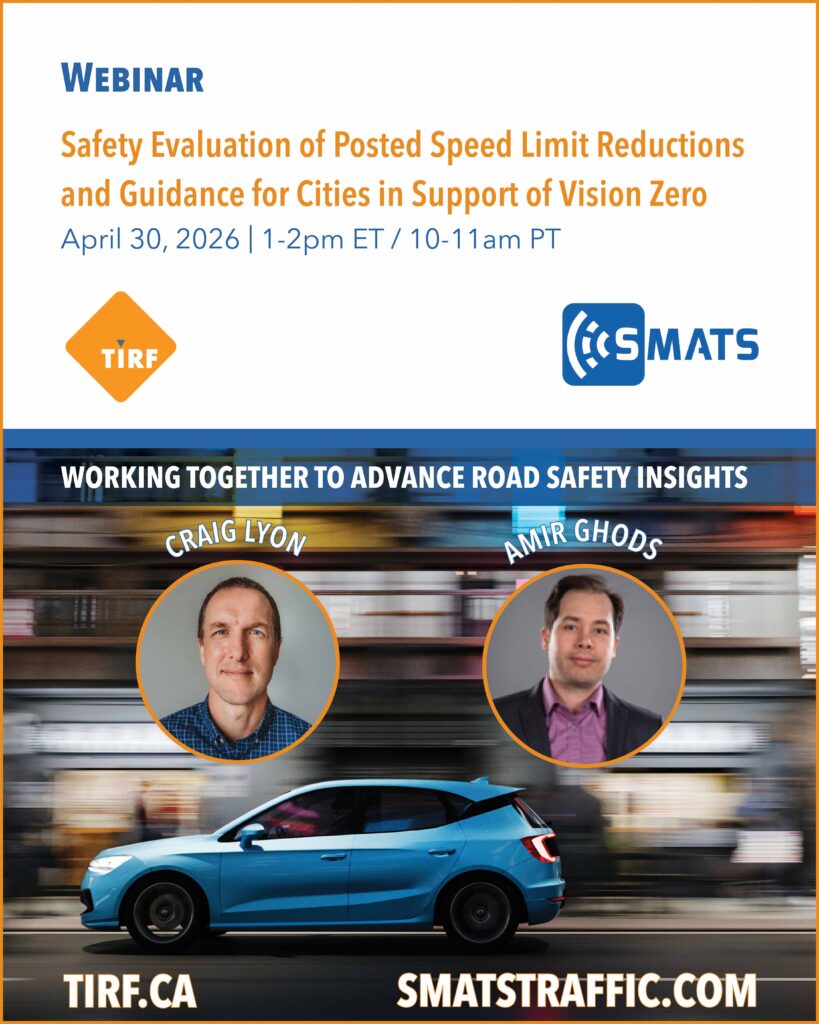
The April 30, 2026 joint webinar, Safety Evaluation of Posted Speed Limit Reductions and Guidance for Cities in Support of Vision Zero, is now available to view. Click here to access the webinar hosted through our partner, SMATS.
Description: Speed limit reductions are increasingly being adopted to support Vision Zero, but their safety impacts may not be uniform across roadway types and operating contexts. Based on a multi-city Canadian study using connected vehicle data, this webinar presents evidence on how posted speed limit reductions affect vehicle speeds and a methodology for estimating the magnitude of these effects. Guidance is also provided to assist municipalities in determining when speed limit reductions alone may be effective and when complementary measures may be needed. It will also introduce predictive statistical models developed to estimate future collision risk using connected vehicle and roadway data that enable a more proactive approach to road safety management. The webinar moves beyond assumptions, applies a structured evaluation framework, and explores how predictive models can support more proactive safety decision-making.