 Who among us hasn’t seen the recent and ongoing debate about automated speed enforcement in news articles and editorials from across the country, particularly in the dueling comment sections. From the perspective of someone who works in road safety, some of these arguments and comments are both astounding; yet completely unsurprising.
As a criminologist and head of an internationally recognized, charitable road safety research institute, I’ve studied crashes for more than two decades. For those of you recently discovering the work of our organization, and who’ve read our recent press release [also published by The Globe & Mail in its entirety] on the World Day of Remembrance for Road Traffic Victims…welcome to the less academic and more personal perspective on automated speed enforcement.
The true impacts of preventable crashes have hit home recently as my husband was struck twice by at-fault drivers taking risks. He was riding on road, training for a race overseas next Spring, wearing full safety gear, visible with flashing lights, and obeying all the rules. The only victim in the first collision (in Europe) was the bicycle, but the second time resulted in emergency surgery; his professional racing bike totaled.
You’ll have to forgive me if this sounds harsh. As I write this, I am unexpectedly on a plane flying home to be with him; I missed the surgery. The next three months of our lives have changed, suddenly. He was more fortunate than most; his arm was broken (sounds weird right – fortunate to have a broken arm). It might sound minor, but it means he can’t train for his race, he can’t walk our two large dogs, drive a vehicle, or do regular chores for the next three months. All of my work-related travel, which is not insignificant, must be cancelled entirely.
I’ll concede some of the viewpoints expressed in the aforementioned automated speed enforcement articles and editorials embody attitudes among a cohort of drivers who are confident in their risk-taking. They are no doubt among drivers who pride themselves on being good; above average even.
I know them well. I’ve heard this viewpoint ad nauseam in newspapers, political debates, call-in radio shows and countless comments.
I’ll tell you where their viewpoint is most obvious…crash statistics. I won’t bore them with details. I’ll just share this one. More than 400 people die in speed-related crashes in Canada every year (that’s one in four fatalities if you’re counting), and thousands more are injured. This isn’t a correlation by the way; it’s causation. In other words, speed and crashes aren’t just related, speed causes crashes.
I’ll also tell you how people are killed and injured on our roads. Many collisions happen on clear days and dry roads. Typically Spring, Summer and Fall have more fatal collisions than Winter, because almost all of us are smart enough to slow down in inclement weather, wet roads and low visibility but this isn’t the case when driving conditions are ideal.
If this cohort of drivers cares to expand their worldview, here’s the truth about speeding.
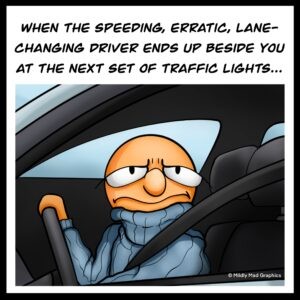
1. Most drivers don’t habitually speed. If they did, no progress would be reported, and deaths would rise exponentially. I’d dare say they’ve encountered these drivers on their daily commute. The ones they speed past to get to the next red light, or almost slam into because they have the audacity to stop on a yellow. They tailgate other drivers to get out of the left lane because they are impatient to sit behind the car in front of them. They pass them on the right. They cut other drivers off while erratically changing lanes endlessly searching for a faster one, which doesn’t exist.
2. There have been countless experiments around the world with increasing speed limits. Every one of them ended with more deaths. That’s fact.
And before they espouse the Autobahn, they should do their homework. I’ve done mine. It paints a different picture. A European Transport Safety Council (ETSC) report showed that among 645 road deaths in Germany, two in three deaths (67%) occurred on stretches without limits while 33% were on stretches with a permanent limit…back in 2006. Yes! We knew, almost two decades ago. Apologies, am I going too fast?
Look no further than British Columbia a decade ago. It surprised no one as speed-related deaths doubled when limits increased to 120km/h from 100km/h. More than half of highway segments showed safety deterioration. Their speeds were subsequently rolled back, or additional safety measures added. This is the magic 15-20km/h they believe is perfectly safe. That didn’t take a rocket scientist to figure out. No policymaker, government official or ardent advocate can change the laws of physics. They should take it up with their higher power.
3. Speed is a main contributor to highway traffic jams. Frustrated drivers racing up to the car crawling ahead, only to hit their brakes, CREATE traffic jams. Their burning desire to fill a car length ahead despite a long line of brake lights staring them in the face serves no one. They ARE the problem grinding everyone to a halt.
4. School buses, cyclists, pedestrians, scooters and heavy trucks have as much right to the road as they do. They are NOT more important. They bring children to school, make the population healthier, deliver goods to their very door. They zip past or around them and cut them off thoughtlessly. They are irrelevant to THEIR commute, errands or outings. These road users can’t hurt speeding drivers. But speeding drivers can and do kill others.
5. Speed limits are based on road design. While they may take a corner faster than indicated or speed on a straight stretch, it doesn’t make them Max Verstappen, and I’ll tell them why. They possess neither the training nor the control, even though they may feel invincible.
The illusion of control

I’ll let them in on a secret. That feeling of control, that belief they are above average is an illusion and I’ll prove it. Drivers only have control when the actions of every other driver can be accurately predicted because everybody else obeys all road rules every moment. Now, when exactly was the last time that happened?
In their last month of driving has another driver cut them off or stopped suddenly? Has a dump truck or a crash ahead halted traffic in its tracks? Has a dog or a deer run into the road? Has a cyclist swerved to avoid a sewer or a parked car? Has a driver changed lanes without signaling, or spontaneously turned at the last moment? Have they had a near miss?
I would lay odds they have. And now that we can agree unexpected events occur every day, can speeders understand why speeding is dangerous?
I hate to break it to them, but the only actions they control on the road are their own. Road rules create predictability so we can consistently anticipate the actions of others. Thankfully, most of us follow the rules most of the time. We aren’t asking for perfection here; just effort.
Better road & vehicle design ≠ driving competence
 Unpredictable drivers create risk; like when they choose to drive 20 km/hr faster. Are they certain nothing unexpected will happen? If they know it will (and by now they should), they must acknowledge they lack control. This makes speeding dangerous.
They have confused better road design and safer vehicle design with their driving competence. Sadly, they are not above average. Tremendous progress reducing crashes is more due to building forgiving roads and vehicles designed to mitigate crashes. A better understanding of risk has educated drivers to make safer choices. But for them, it created the mistaken illusion that they are better drivers. They have misinterpreted the facts as complete control to handle any unexpected event.
But we all know they can’t because they can’t predict these events. Faster speeds mean they have neither time nor the distance to safely avoid collisions. This is how people are killed and injured. Statistics prove it. These numbers are family, neighbours, colleagues, friends; maybe not theirs’ but definitely someone’s. The pain is also etched into the faces of countless first responders attending crash scenes; desperately hoping to rescue a victim, still breathing; not recover a body, still warm.
The reason we need automated speed enforcement is…?
If they are still struggling to understand automated speed enforcement, I’ll spell it out. Drivers such as them, unlike most of us, have failed to absorb five decades of education and enforcement campaigns. We’ve known speed kills for decades, hence laws against speeding. We criminalize behaviours that hurt people.

Moreover, the application of traffic calming measures have been entirely lost on them as have reductions in speed limits everywhere. We need automated speed enforcement BECAUSE of them.
Another fact their arguments overlook is widespread support for automated speed enforcement. No doubt it’s those fictitious drivers who don’t speed they harped about, and those imaginary drivers who did change their behaviour because of it. Studies confirm it if they’d slow down to look.
The only real question is What will change their behaviour? If the answer is nothing, let me tell you how the story ends. It’s three words they’ll like even less than automated speed enforcement.
Intelligent. Speed. Adaptation. (ISA)
If you’ve not yet heard of this, it means we place our trust in vehicles to make the smart choice because we no longer have confidence in drivers like them to do so.
There is still more research needed, policy questions to answer, and political reluctance to overcome.
But I’m confident we’ll implement some form of ISA…faster…with the help of drivers who speed.
#MySafeRoadHome blog co-authors: Robyn Robertson, TIRF President & CEO, holds a Master of Criminology Applied degree. During her 25 years in the research field, Ms. Robertson has published more than 350 reports and articles on a broad range of road safety issues with a focus on education, policy and program development and evaluation. She has delivered technical assistance for road safety programs in several countries and is the author of TIRF’s knowledge translation model which is the basis for TIRF’s many educational programs. Robyn is well-versed in implementation strategies and operational practices across transportation, criminal justice and health systems, and industry. She is a member of, or has served on, several academic and professional Board and committees.
Related topics:
 |
 |
 |
 |