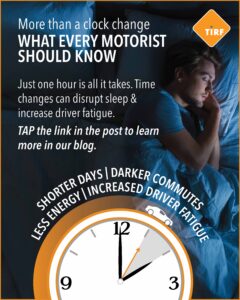
 Daylight Saving Time is generally a welcome sign spring is almost upon us with longer days and more hours of sunlight to enjoy. However, the move back to Standard Time in much of the populated Northern hemisphere can be met with a foreboding of the approaching winter as daylight ebbs and the daily temperatures dip. It’s also time for the semi-annual discussion for many Canadian jurisdictions about the wisdom, or lack thereof, of continuing the practice to spring forward or fall back. It’s not a simple process with commitments to implementing this change hinging on the choices of neighbouring jurisdictions both within, and outside, Canada.
Aside from the ongoing debate about the annual move from Daylight Saving Time to Standard Time and vice-versa, many of us at this time of the year are quite simply not looking forward to spending much of our day in the dark. For those of us already missing long summer evenings (us, that’s us), there’s a handy way to see how a time change really shifts our daylight. The National Resource Council of Canada maintains a sunrise/sunset calculator, which demonstrates how a permanent time change would affect your daylight hours. While there are pros and cons to both systems, the pros are not universal, as it depends on where a jurisdiction within a time zone is located to receive maximum sun benefits. Given autumn is associated with changes in our routines as school is back in session and fall and winter activities and sports start again, we’re all pretty exhausted in adjusting to the new normal and missing the long, lazy days of summer. The loss of sunny day energy and optimism feeds our mental and physical fatigue.
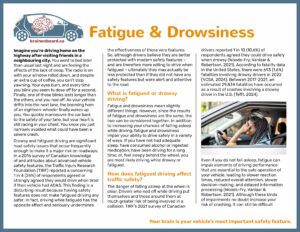
Fatigue warning signs
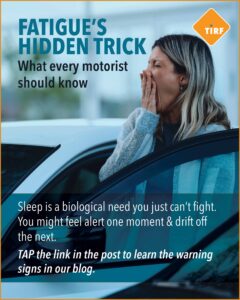
One of the most important facts about fatigue is that people are terrible at estimating when they will fall asleep. It’s like when you’re sitting on the couch, watching a movie, and suddenly you wake up and the credits are rolling. Even if you don’t feel tired, sleep is a biological need you just can’t fight.

Signs of fatigue include:
- frequent yawning
- sore, tired eyes or difficulty keeping your eyes open
- having trouble keeping your head up, nodding off
- boredom and/or loss of concentration
- irritability
- slow reactions
- hallucinations
What this means for your ability to drive is:
- failing to check mirrors
- lane drifting and/or missing exits or turns
- inconsistent speed, drifting out of your lane, and/or erratic braking
- inability to remember driving the last few kilometres
What you need to remember, is that all these behaviours increase crash risk.
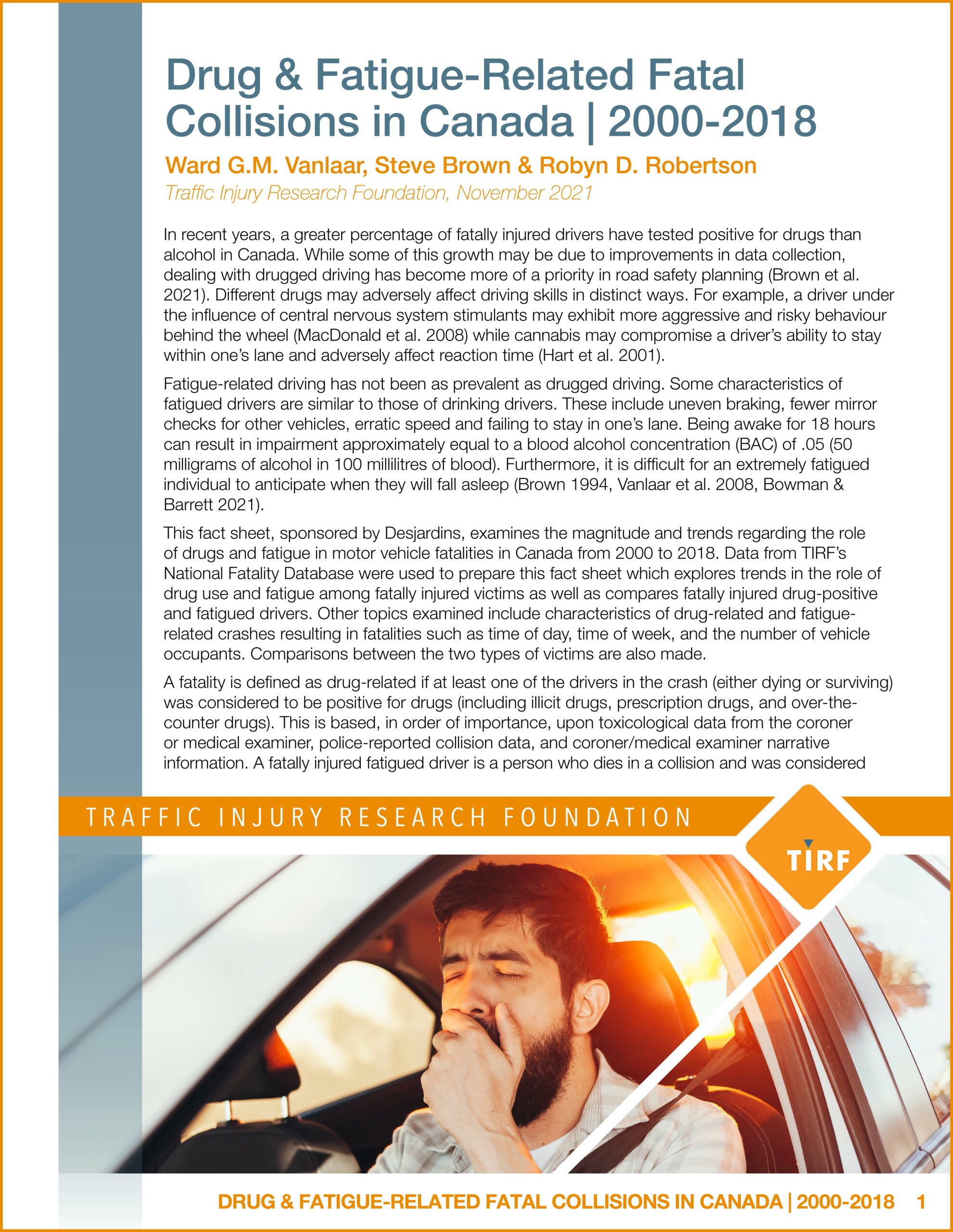
In a 2021 TIRF fact sheet, 72% of respondents reported they drive when tired or fatigued and 13% admitted they had fallen asleep or nodded off while driving at least once in the past year. According to the TIRF National Fatality Database, from 2000-2022, 32% of fatigue-related fatalities occurred between 12:00pm–6:00pm. This was followed by 31% of fatigue-related fatalities occurring between 3:00am–9:00am.
While the 3:00am–9:00am time frame is expected (is anyone a morning person?), you may be surprised by the afternoon time frame. But in the afternoon, your body’s circadian rhythm (i.e., your body’s internal 24-hour clock that regulates sleep-wake cycles) creates a natural energy dip, which can be exacerbated by factors like a time change resulting in poor sleep, a heavy or carbohydrate-rich lunch, dehydration, and stress. Sounds like the average workday, doesn’t it? But instead, we must get into our car and sit in traffic to get home. Sitting in your car after a long day can further your drowsiness, making you less likely to react to risks and be inconsistent with speed and/or breaking.
How drowsy driving compares to impaired driving
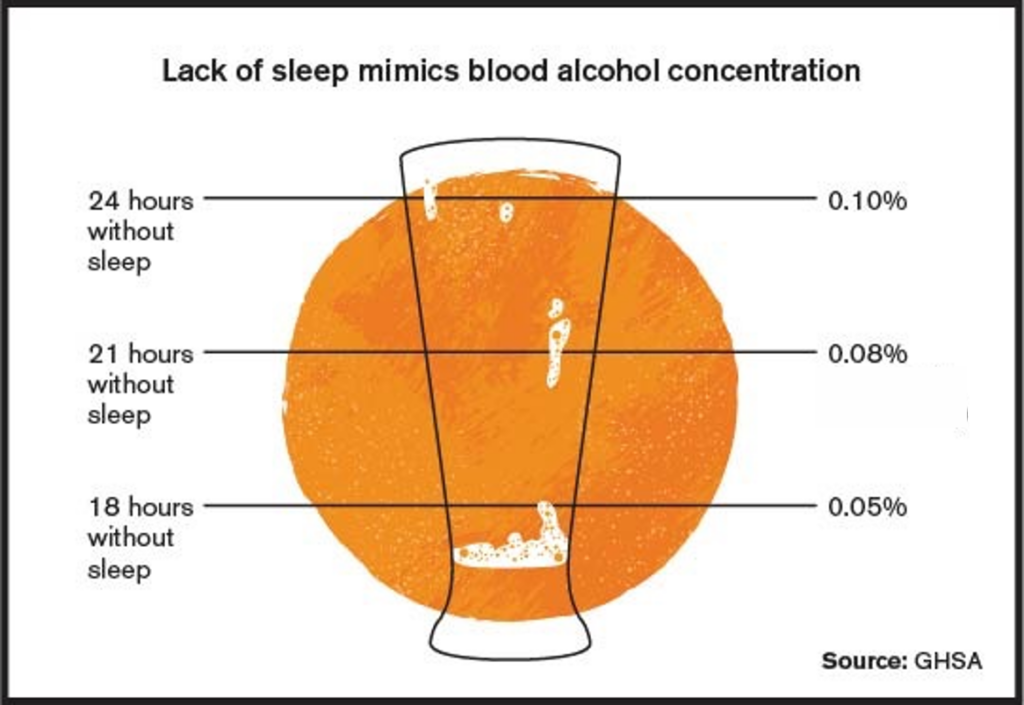 Did you know fatigued driving is as unsafe as driving with alcohol in your body? Being awake for 18 hours can produce impairment approximately equal to a blood alcohol concentration (BAC) of .05 (50 milligrams of alcohol in 100 millilitres of blood). After 24 hours awake, impairment rises roughly to the equivalent of a BAC of .10. To put this in perspective, the Canadian Criminal Code BAC is .08 and provincial legislation for administrative sanctions is as low as .04 in Saskatchewan and .05 in British Columbia and Ontario.
The dangers of driving after drinking are well known and most of us plan to have a designated driver or rideshare pick us up after a night out. So, why not do the same when you’re tired? Additionally, it is also important to double-check your prescription(s) and over-the-counter medication labels to see if increased drowsiness could result from their use. Some medications will increase your feeling of fatigue, so it is important to not drive while taking these medications and/or ensure you get more rest. When driving fatigued or drowsy, it not only puts the driver at risk but other road users as well.
Move to Standard Time & tiredness

The impact of the sunlight lost from falling back an hour affects each of us differently. Some of us can adapt better to waking up in the dark and eating dinner in darkness. For others, the effects of this shift can feel like a bad case of jet lag and it actually takes a day or more to adjust. Basically, our circadian rhythm, which is the body’s biological sleep-wake cycle, must shift to accommodate the new schedule throughout Autumn and Winter. Most of us feel sleepy twice a day – in the afternoon and at night. Without the proper amount of sleep, tiredness occurs and once a person is tired there is no cure for tiredness other than sleep itself. So, if you have a sleep debt (meaning you didn’t have enough sleep to begin with) before the time change and decrease in sunlight, you’re probably going to experience increased fatigue or tiredness. The bottom line is the amount of sleep you get and how tired you are can really affect your driving skills, so it’s important to stay out of the driver’s seat when tired.
How do you cure tiredness?
Many drivers use a variety of tactics to combat fatigue. These commonly used solutions have NO evidence of effectiveness:
- turning up the music/podcast
- opening windows
- talking to passengers
- eating

Even a caffeine infusion from coffee, tea or energy drinks or taking quick breaks have very limited and short-term effects on fatigue. The safest and most effective strategy is to plan ahead and get enough rest before driving. You can also ask a non-tired passenger to take over driving, or opt for public transportation, taxi, or ride-share service. If none of these options are available and you exhibit any of the signs of fatigue, take a break from driving, (safely) park your vehicle at a rest stop and take a nap. Even just 20 minutes can make a difference.
 The line between work life and home life has blurred for many with increasing pressure to maintain productivity and perhaps find new ways to deliver services virtually. These challenges can be magnified should one experience the effects of seasonal affective disorder brought on by the darkness of winter. All can cause agitation or anxiety resulting in insomnia. It’s a lot and there’s no shame in admitting when help is needed. As a society, toning down the demands of life and our approach to work/life balance is essential to both our mental and physical well-being. Also, given reduced travel options during the pandemic, it’s important to limit driving when travelling to other time zones, at least until you have had a chance to acclimate. If you think you might be too tired to drive, you likely are, so just don’t.
Absolutely nothing is more important than your safety and that of others sharing the road.
#MySafeRoadHome blog co-authors: Karen Bowman, Director, Communications & Programs (Drop It And Drive® program), Hannah Barrett, TIRF Researcher & Program Manager, and Carl Wicklund, TIRF USA Senior Advisor, work collaboratively as co-authors. Karen has led the DIAD program since 2010 which, to date, has been delivered to over 65,000 youth and workers across North America. She uses her writing and blogging background to help apply TIRF’s research to real-world driving. Hannah is a criminologist and specializes in alcohol ignition interlock programs, wildlife-vehicle collisions, and impaired driving countermeasures. Carl Wicklund has over 47 years of experience in the corrections/human services field.
Related topics:
 |
 |
 |
Source documents & resources:
Brown, S., Vanlaar, W. G. M., & Robertson, R. D. (2020). Fatigue-related fatal collisions in Canada, 2000-2016. Traffic Injury Research Foundation: Ottawa, ON. https://tirf.ca/download/drug-fatigue-related-fatal-collisions-canada-2000-2018/
Carmen, T., Ram, A., & Bruce, G. (March 2025). Chasing daylight, CBC News, https://www.cbc.ca/newsinteractives/features/daylight-saving-time
Dawson, D., & Reid, K. (1997). Fatigue, alcohol and performance impairment. Nature, 388(6639), 235-235.
National Research Council Canada. (2020, April 24). Sunrise/sunset calculator. https://nrc.canada.ca/en/research-development/products-services/software-applications/sun-calculator/
Orsini, F., Giusti, G., Zarantonello, L., Costa, R., Montagnese, S., & Rossi, R. (2023). Driving fatigue increases after the Spring transition to Daylight Saving Time in young male drivers: A pilot study. Transportation research part F: traffic psychology and behaviour, 99, 83-97.
Scoditti, E., & Garbarino, S. (2022). Nutrition, Sleep, Circadian Rhythms, and Health Implications:“Come Together”. Nutrients, 14(23), 5105.
Sprajcer, M., Dawson, D., Kosmadopoulos, A., Sach, E. J., Crowther, M. E., Sargent, C., & Roach, G. D. (2023). How tired is too tired to drive? A systematic review assessing the use of prior sleep duration to detect driving impairment. Nature and science of sleep, 175-206.
Vanlaar, W. G. M., Brown, S. & Robertson, R. D. (2021). Drug & fatigue related fatal collisions in Canada, 2000-2018. Traffic Injury Research Foundation: Ottawa, ON.