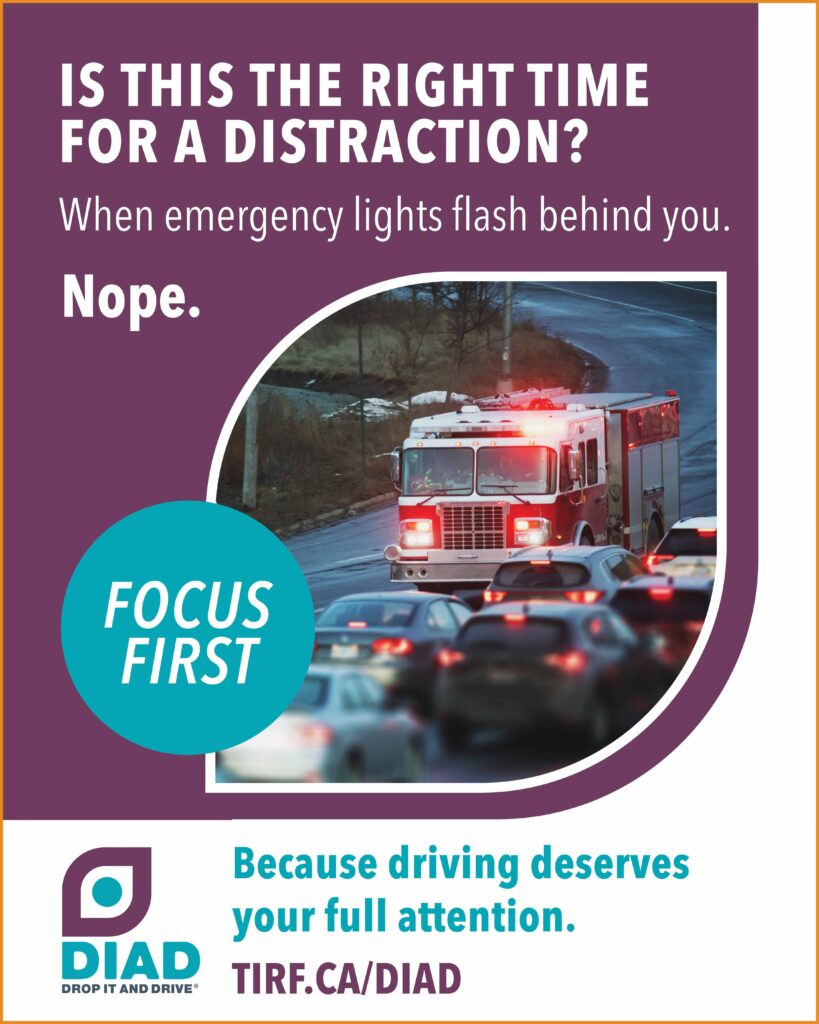
 Each year, collisions on Canadian roads have devastating consequences for communities across the country. In particular, distracted driving which we have all observed, including when drivers slow down to rubberneck at collision scenes, is a contributing factor in one in four fatalities. In addition to some of the more obvious concerns centred understandably on the victims, families and communities who are directly impacted by crashes, there are also the less obvious immediate and long-term consequences for first responders, including police, fire and paramedics, who attend crash scenes. The effects of these preventable collisions are not only psychological but also pose a very real threat to first responders and other roadside workers while they work to clear crashes and attend to victims on the road or at the roadside.
Police services and first responders are committed to protecting the lives and safety of everyone on the roads, regardless of circumstances. These professionals willingly place themselves in harm’s way to enforce traffic laws and mitigate loss of life when crashes occur. First responders attend far too many crash scenes throughout their careers and carry with them the tragic outcomes.
The Canadian Automobile Association recognizes Slow Down Move Over Day in May (CAA, May 2025) each year, and in British Columbia, the RCMP declared April 2026 its first ever Slow Down Move Over Month, reminding drivers to use the 70/40 rule:
- When the normal speed limit is 80 km/h or higher, drivers must slow down to 70 km/h or less.
- When the normal speed limit is below 80 km/h, drivers must slow down to 40 km/h or less.
Between 2018 and 2022, there were 8,350 fatal collisions which claimed 9,154 lives and 462,737 injury collisions resulting in serious and minor injuries among 619,840 individuals. These crashes are not just numbers. For all of those involved, including first responders, it is very personal.
Distraction & roadside safety
 Retired Captain Tim Baillie (Surrey Fire Service), TIRF’s Drop It And Drive® co-founder and presenter since 2010 and now City Councillor for the Township of Langley, shares his experiences as a first responder during DIAD interactive workshops to help increase awareness among youth, communities and workplaces, about the impact of preventable collisions not only for the victims but also those working these crash scenes. He wants to help people understand that distracted driving, in particular, is a contributing factor in motor vehicle collisions which play a role in significant critical incident stress for firefighters.
TIRF’s 2024 fatality database fact sheet revealed the percentage of fatalities that were distraction-related increased to 28.8% in 2021 from 19.1% in 2000. In addition, fatally injured drivers between 16-19 years old (20.6%) as well as those who were 65 and older (20.4%) were the most likely to have been distracted. Among other risky driving behaviours, this is a wake-up call that general educational messages and awareness campaigns may be falling on deaf ears, particularly if people don’t recognize they are distracted. We can and should do more to keep each other safe on, and near, roadways by making safe choices at the wheel…this includes ensuring the safety of roadside workers.
 During his 27 years as a professional firefighter and into retirement from the industry, Tim has seen firsthand the horrific results of first responder critical incident stress and believes knowledge and training will help those who help others.
Crash scenes, wherever they occur, are a first responder’s place of work, and we need to assist them in performing their duties by keeping them safe. Their efforts not only help prevent the future loss of life but also provide victims with the immediate care they need and families with the answers to help them move forward. Slow Down Move Over laws across Canada are in place to do exactly that…protect first responders and other roadside workers so they can save lives.
Keeping first responders & roadside workers safe

Results from a AAA Foundation for Traffic Safety study (2015-2021) found an increasing trend in the number of deaths among roadside assistance providers each year. The study identified 123 roadside assistance providers who were fatally killed while working at incidents on the road or at the roadside during this period. The study showed that approximately 25% of crashes involving roadside assistance providers occurred in the travel lanes of the roadway. This emphasizes the need for better compliance with Slow Down, Move Over laws, which require drivers to move over a lane and/or reduce speed when passing roadside assistance providers, emergency services, and other roadside workers. However, more than 50% of these crashes occurred when the driver of the vehicle striking the roadside worker veered off the road and hit the roadside assistance provider on the shoulder or roadside. This suggests the possible influence of factors like impairment, fatigue, or distraction, although it’s not conclusive. While the exact cause for these incidents is more difficult to determine, there is an opportunity for all drivers to take steps to prevent these roadside collisions and keep both victims, first responders and other roadside workers safe.
We’re grateful for our first responder partners who share their decades of personal experiences and wisdom to help first responders get to incidents as quickly and safely as possible as well as how to keep them and other roadside workers safe once on scene.
Slow Down Move Over safety tips for drivers:
- Pay attention to your surroundings to ensure a clear path of travel for fire, paramedic and police services.
- Allow emergency vehicles to pass by giving them a clear path by moving to the closest roadside edge. Note: This may be either the curb or centre median depending on the approach of the emergency vehicle.
- Pay attention to what other drivers are doing & do the same to provide a clear path of travel.
- If at a traffic light, and you can’t move, put your brake lights on. This lets emergency vehicle drivers know you plan to stay still and can then safely move around you.
- When passing a roadside incident, pay attention to your driving, not the crash scene.
Note: This prevents drivers from inadvertently steering in the direction they’re looking which can explain why, when looking at a crash scene, drivers can find themselves driving towards it…sometimes causing a secondary collision. And, to understand how drivers can strike an emergency vehicle even with all its lights engaged, the difference between looking and seeing is explained in Distracted Driving Facts.
To support efforts to keep first responders and roadside workers safe, our Canadian Coalition on Distracted Driving developed fact sheets to raise awareness about the toll of preventable collisions and to share insider knowledge of crash scene management with the public to help keep first responders safe while on the job.
Driving is both a responsibility and a privilege. With that, individuals hold the power to reduce road risks for all users. Everyone has the right to get home safe every day; not just physically, but also emotionally.
Slow Down Move Over rules remind us of our shared responsibility to keep first responders and roadside workers safe…let’s all commit to it daily.
References & source documents:
Public Safety Canada. (2019). Supporting Canada’s public safety personnel: An action plan on post-traumatic stress injuries. https://www.publicsafety.gc.ca/cnt/rsrcs/pblctns/2019-ctn-pln-ptsi/index-en.aspx
Carleton, R. N., Afifi, T. O., Taillieu, T., Turner, S., Mason, J. E., Ricciardelli, R., … Asmundson, G. J. G. (2018). Mental disorder symptoms among public safety personnel in Canada. Canadian Journal of Psychiatry, 63(1), 54–64. https://doi.org/10.1177/0706743717723825
AAA Foundation for Traffic Safety. (2024, January). Roadside assistance providers fatally struck by vehicles at the roadside: Incidence and characteristics. https://aaafoundation.org/roadside-assistance-providers-fatally-struck-by-vehicles-at-the-roadside-incidence-and-characteristics/
Government of British Columbia. (2026, March 19). Slow down, move over. https://www2.gov.bc.ca/gov/content/transportation/driving-and-cycling/road-safety-rules-and-consequences/slow-down-move-over
Ministry of Transportation and Transit. (2015, January 2). One change to slow down and move over rule improves safety. TranBC. https://www.tranbc.ca/2015/01/02/one-change-to-slow-down-move-over-rule-improves-safety/
#MySafeRoadHome blog authors: Karen Bowman, Director, Communications & Programs (Drop It And Drive® program) and Robyn Robertson, TIRF President & CEO, work collaboratively as co-authors, drawing from Robyn’s breadth of knowledge on topics alongside Karen’s blogging and writing background, and her experience leading the DIAD program since 2010. To date, the DIAD program has been delivered to over 65,000 youth and workers across North America. Robyn is the author of TIRF’s knowledge translation model and is well-versed in implementation strategies and operational practices across several sectors.
 |
 |
 |
 |