Working together to make safe driving second nature
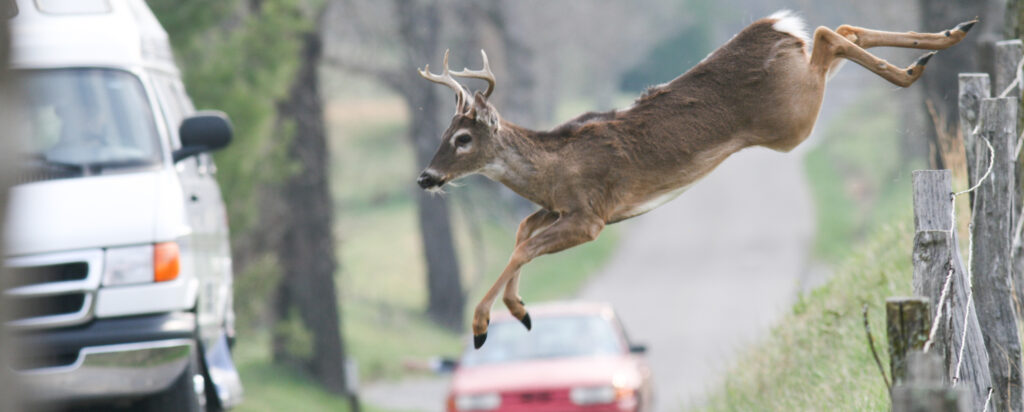
Wildlife-vehicle collisions are a serious road safety concern that can happen anywhere, at any time. Whether it’s a deer suddenly crossing the road, a raccoon darting out from the roadside, or a larger animal appearing unexpectedly in your path, these encounters can happen in the blink of an eye. And in parts of Canada that skipped this fall’s time change, the usual extra hour of morning light never arrived. People driving, cycling or walking to work and school are now setting out in the dark or near dawn, which means they may cross paths with wildlife at times of day when they’re used to seeing none.
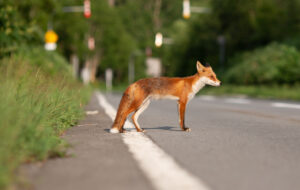
 The consequences can be significant, resulting in vehicle damage, injuries, and, unfortunately, harm to wildlife. While we can’t always predict when an animal might cross our path, there are steps we can take to reduce the risk. From staying alert and adjusting our driving habits to knowing how to react when wildlife appears, a little awareness can go a long way. In this blog post, we’ll explore why wildlife collisions happen, where and when drivers should be extra cautious, and practical tips to help keep both people and animals safe on the road.
Collisions between wildlife and vehicles can have deadly consequences for both people and animals. It may surprise you to learn that collisions are more often caused by drivers striking other vehicles or losing control of their own vehicles as they swerve to avoid animals. Between 2000 and 2023, 687 persons died in wildlife-vehicle collisions (WVCs) in Canada.
 While WVCs can occur at any time, summer is the peak season for WVCs because of increased animal movement, environmental stressors, and higher summer road traffic overlap. In fact, more than one-third (n=281) of WVCs in Canada occur in the summer, followed by fall (n=240) (TIRF Fatality Database, 2026). Fall is when many animals are starting to prepare for winter and/or migrating, meaning they are more likely to be on the move and crossing roadways. It is also deer mating season, and male deer are more active and aggressive during this time. U.S. crash data show deer-vehicle collisions jump by about 16% when clocks fall back, because the evening commute suddenly happens after dark. Those provinces skipping this year’s time change keep that extra evening light but did trade it for darker mornings.
So, as you’re driving home from work, soccer practice, or dance class, remember to be alert and on the lookout for wildlife.
How seasons, habitat & behaviour put wildlife on the road
 Summer is the peak season for collisions. Increased animal movement, environmental stressors, and greater summer road traffic mean more overlap between wildlife and vehicles. In summer months, young animals born in the spring begin roaming more independently alongside their mothers, making their road crossings less predictable.
- Fall and winter are critical times for many species as they engage in mating and migration activities. These behaviours often lead wildlife onto and near roadways as they search for partners or better feeding grounds.
- With shorter daylight hours, visibility becomes a challenge for both drivers and wildlife. The increased darkness can make it difficult for drivers to spot animals in time to react.
- Wildlife may venture closer to roadways in search of food sources that are more abundant in urban areas, such as roadside vegetation and discarded human food.
- Roads often divide animal habitats and act like a barrier to movements associated with the various needs of wildlife such as water and food sources or migration and mating activities. Wildlife will cross roads to reach these destinations; however, their natural defences designed to act against predators are not very useful to protect them from or to help them avoid vehicles.
- Roads offer easy walking and wide spaces for animals to move around, particularly in the winter when it is difficult to move through deep snow.
 Summer is the peak season for collisions. Increased animal movement, environmental stressors, and greater summer road traffic mean more overlap between wildlife and vehicles. In summer months, young animals born in the spring begin roaming more independently alongside their mothers, making their road crossings less predictable.
Why wildlife-vehicle collisions peak in summer & after dark
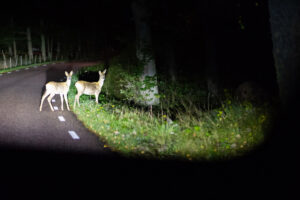 The higher frequency of reported collisions in the summer corresponds to the greater likelihood of encountering wildlife at this time of year due to increased animal movement. Moose have increased movement June through August as they travel to wetlands and search for vegetation. Additionally, during these months, spring-born offspring begin exploring independent territory and foraging on their own during the summer, increasing unexpected road crossings. While these collisions can happen at any time of day, the risk of a WVC increases significantly at night.
Why at night? Well, many animals are nocturnal, meaning they are more active at night than during the day. They are more likely to be crossing roads and highways when it is dark outside. Additionally, the headlights of vehicles can be disorienting for animals, making it more difficult for them to judge distances and speeds.
The consequences of wildlife-vehicle collisions can be severe for both humans and animals. Collisions can result in injuries or fatalities for drivers and passengers, as well as for the animals involved.
Three ways to lower the risk of a WVC at night
There are several strategies that can be used to reduce the risk of wildlife-vehicle collisions at night.
- Slow down and stay alert. This means obeying posted speed limits, avoiding distractions (such as using a cell phone or taking your eyes off the road to navigate increasingly complex touchscreens), and staying focused on the road ahead. Drivers should also be aware of their surroundings and watch for signs of wildlife activity, such as animal crossings.
- Use high beams when safe. When driving at night, high beams can help increase visibility and give drivers more time to react if an animal is spotted on the road.
PSA #1: Turn off high beams when there is oncoming traffic or when following another vehicle, as this can be dangerous and distracting for other drivers.
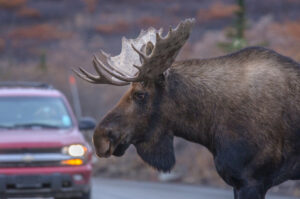
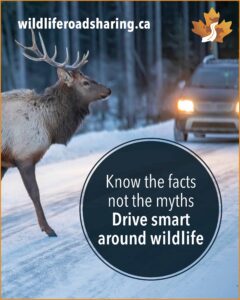
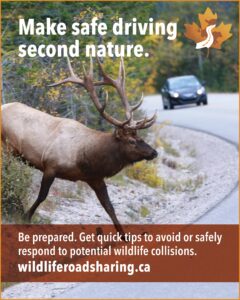
 Be prepared to react. If you do see small wildlife on the road, it is important to know how to react safely for you, other road users and, where possible, to keep wildlife safe. The safest response to wildlife on the road is for drivers to slow down in a controlled manner and steer straight, even if the animal is in the path of the vehicle. It is important to remember you shouldn’t slam on your brakes. However, if you see a moose or elk on the road, the safest response (although understandably hard to do) is for drivers to slow down and aim their vehicle at the flanks (rear) of the moose. Aiming for the flank of the moose minimizes the risk of the moose or elk sliding across the hood of the car. This is important as it may minimize the damage caused by the full weight of the moose’s upper body impacting the windshield and roof of the vehicle.
 Be prepared to react. If you do see small wildlife on the road, it is important to know how to react safely for you, other road users and, where possible, to keep wildlife safe. The safest response to wildlife on the road is for drivers to slow down in a controlled manner and steer straight, even if the animal is in the path of the vehicle. It is important to remember you shouldn’t slam on your brakes. However, if you see a moose or elk on the road, the safest response (although understandably hard to do) is for drivers to slow down and aim their vehicle at the flanks (rear) of the moose. Aiming for the flank of the moose minimizes the risk of the moose or elk sliding across the hood of the car. This is important as it may minimize the damage caused by the full weight of the moose’s upper body impacting the windshield and roof of the vehicle.
PSA #2: Most animals are not likely to remain still, and since their behaviour is unpredictable, drivers cannot anticipate which direction the animal will move.
A year-round checklist for preventing wildlife collisions
PSA #3: The best defence is simple: slow down in wildlife areas, stay alert, and think ahead about how you would react.
 Work, school and planned activity (those early, early morning hockey practice times) commutes are what they are, when they are. There may, however, be times when driving during peak risky periods for wildlife interactions can be avoided. Consider skipping that late night snack run and instead, schedule running those errands during daylight hours.
Be prepared.
- Expect wildlife at any time. Risk is highest in the hour before and after dusk and dawn, during summer months and October and November, and on two-lane highways with speeds of 80 km/h or more.
- Where there is one animal, there are often more. Scan the area for others.
Drive smart.
- Leave room. Other drivers may not know how to react and could swerve into you.
- Use your seatbelt and headlights.
Watch…
- For movement and, at night, glowing eyes.
- For wildlife warning signs.
- For flickering lights from other vehicles, which can signal an animal crossing.
- For vehicles pulled over or slowing suddenly. They may have spotted something you haven’t.
- Ask passengers to call out sightings, like “Deer on the left!” Yes, we’re officially giving backseat drivers permission to speak up.
Do not…
- Drive fatigued, impaired, or distracted.
- Speed, in wildlife areas or anywhere. Slower speeds give you time to spot animals and respond.
- It attracts animals to the roadside.
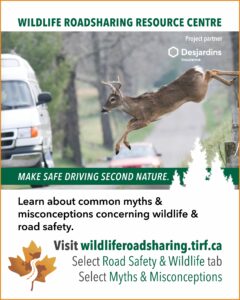
Many more tips are available on our Wildlife Roadsharing Resource Centre: https://wildliferoadsharing.tirf.ca/road-safety-and-wildlife/road-safety.
Make wildlife safety a habit, one drive at a time
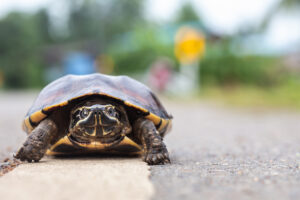 Mitigating wildlife collisions in the fall and winter is a critical aspect of road safety. By understanding the contributing factors of these collisions and adopting preventive measures, we can make our roads safer for both humans and wildlife. WVCs are a problem that is heightened at night, but vigilance to prevent these collisions is recommended 365 days a year, 24 hours a day, 7 days a week. By taking steps to reduce vehicle speed, improve lighting, build wildlife crossings, and raise awareness among drivers, we can reduce the likelihood of these collisions and protect both human and animal lives.
When it comes to driving, the last thing you want is to encounter a wild animal on the road. But when we do, it’s important to know how to react and take into consideration the tips we shared in strategy #2. So as the days get shorter (and colder!) remember that with decreased daylight comes an increased potential for wildlife on roads. Stay alert, slow down, and be prepared to react!
#MySafeRoadHome blog authors: Hannah Barrett, TIRF Researcher & Program Manager and Karen Bowman, Director, Communications & Programs work collaboratively as co-authors. Hannah is a criminologist and specializes in alcohol ignition interlock programs, wildlife-vehicle collisions, and impaired driving countermeasures. Karen is a road safety educator and communicator whose Drop It And Drive® programs have reached more than 65,000 people across North America. She draws on her writing background to help apply TIRF’s research to real-world driving, cycling and walking.
Source documents and resources:
Wildlife-Vehicle Collisions in Canada | 2000-2020 https://tirf.ca/download/wildlife-vehicle-collisions-canada-2000-2020
Canada Winter Forecast 2026–2027: What’s Ahead This Winter?
https://www.almanac.com/winter-forecast-canada
Cunningham CX, Nuñez TA, Hentati Y, et al., Prugh LR. “Permanent daylight saving time would reduce deer-vehicle collisions.” Current Biology 32(22): 4982–4988, 2022. DOI: https://doi.org/10.1016/j.cub.2022.10.007
Daylight saving time can decrease the frequency of wildlife-vehicle collisions, https://doi.org/10.1098/rsbl.2016.0632
Road Safety: Taming the Wild Road, TIRF Insights/Blog video PSA in partnership with Desjardins https://tirf.ca/blog/road-safety-taming-the-wild-road
Transport Canada Guidelines to Limit Distraction from Visual Displays in Vehicles
https://tc.canada.ca/en/road-transportation/stay-safe-when-driving/transport-canada-guidelines-limit-distraction-visual-displays-vehicles
Related topics:
 |
 |
 |
 |