
When I was a young boy, it was rare to know anyone who lived past 80 years. Now, it is not uncommon at all. This has resulted in increased numbers of older drivers on our roadways. According to a 2021 study, the number of drivers age 65 and older is growing, creating a concern about the potential increase in fatal crashes involving aging drivers. This blog addresses some of the potential driving challenges faced by older drivers like me. I must admit, this blog was humbling for me to research and put to paper.

As a septuagenarian who has driven for nearly six decades, I have chosen to take a triennial safe driver course for drivers 55 years and older. Successful course completion in Minnesota entitles me to a 10% savings on my auto insurance. I’m uncertain how many states, provinces, or countries provide this opportunity, but the safety information presented and gleaned, and the savings realized from the course make it a worthwhile endeavor for senior drivers. Additionally, even though I don’t often consider myself old (at least mentally), the course did get me thinking about some potential driving challenges as I age.
Cognitive & physical challenges
 One of the most notable aspects of aging is the potential cognitive declines which can be coupled with physical challenges. Age-related transformations, which occur for individuals at different rates, may be intensified by medical conditions and medications, making toggle-tasking (sorry to inform that multi-tasking is a myth, but that’s for another blog), reaction time, and awareness of surroundings more difficult. This deterioration can amplify the risk of crashes and result in, particularly when navigating complex situations like intersections, left turns, and responses to an impending crash.
So how does aging potentially have an impact on one’s driving ability? Let’s look more closely at the cognitive and physical issues that may influence one’s driving capabilities.
Changes in cognition & the impact on driving
Don’t panic aging drivers! Although I am reluctant to accept the reality, as I age, I may begin to face cognitive challenges which will affect my driving abilities. We all age differently and even with mild cognitive decline one may still be able to drive safely. So, rather than assuming cognitive decline based on age, relying on self-assessment and tests of functional ability to drive will likely provide better indicators of one’s capacity to drive safely.
 Contributing factors like impaired attention, executive function, memory, and visuospatial skills (e.g., judging distances when turning left or parking your car) skills may cause other errors like lane weaving, low- or high-speed violations, and/or missing or ignoring road signs. Further cognitive decline features that can contribute to driving challenges are difficulty with complex decisions, slower reaction times, poor judgment, and even neuropsychiatric symptoms like anxiety or paranoia . Specifically, as cognitive deficits increasingly manifest they may negatively have an impact on driving in one or more of the following ways:
- Grappling with divided attention and tasks while stressed may lead to blunders in judgment, information processing, and navigating complex driving scenarios.
- Diminished visuospatial skills can make it harder to accurately assess distances, steering into or out of spaces, and/or understanding visual cues.
- Particularly with more advanced cognitive decline, impacts on memory (long-term and working), can impair route recall, complex instruction comprehension, and timely decision-making.
These cognitive functions are all necessary to maintain competent driving skills and help with hazard detection and reaction times to avoid collisions.
Physical changes & the impact on driving
Older drivers may also experience physical limitations. More specifically, the following physical changes and challenges can have a deleterious effect on older drivers’ capacity to effectively operate a vehicle safely:
- Vision problems can come about if one has cataracts, glaucoma, or macular degeneration. These conditions can bring about vision loss, difficulty driving at night, weakened contrast sensitivity, and reduced peripheral vision.
- Hearing loss makes it difficult to hear horns, sirens, and street sounds.
- Reflexes slow and it is harder to respond quickly to road obstacles and hazards and reaction time increases.
- Difficulty looking back to check blind spots, steering or pressing gas and brake pedals due to arthritic pain and stiffness.
- Conditions like Parkinson’s disease, heart disease, strokes, and diabetes can have an impact on vision and muscle control.
- Many older drivers are taking one or more, maybe many more, medications that can cause slow reaction times, confusion, or drowsiness. Medications when taken in combination may especially cause negative mental and physical reactions.
Practical tips for aging drivers
Because cognitive and physical skills will at some point begin to decline, it doesn’t mean you’re an unsafe driver. So, rather than assuming cognitive and physical decline based on age, relying on self-assessment and tests of functional ability to drive will likely provide better indicators of one’s fitness to drive safely. As an example, I’m confident I’m a capable and safe driver despite my advanced age. Admittedly, I do have a couple of friends of the same age who should not be driving and have opted to stop. So, although I hate to admit it, conducting self-evaluations and, if necessary, participating in medical screenings and driving evaluations make sense as I age. I also think it makes sense to begin to have conversations with family and/or trusted friends about safe driving if cognitive and physical declines begin to manifest.

Some self-assessment indicators of ability to drive safely (gleaned from olderdrivers.org.uk) might include, but are not limited to, asking yourself the following questions:
- Has your confidence to drive waned and are you reluctant to drive the posted speed limit?
- Are other drivers honking at you on a regular basis?
- Do you have difficulty with turns, especially left turns?
- Are you having trouble seeing street signs or road lines and is night-time driving difficult?
- Have you recently had one or more fender-benders or near-misses?
- Have you found yourself lost on familiar routes?
- Do you struggle to stay in your lane?
- Is moving your foot between the gas and brake pedals difficult?
- Do newer technologies in your car confuse you and disrupt your ability to concentrate on driving?
One or more affirmative answers to these self-inquiries should give you pause and suggest that you may need to honestly determine if or when you are safe to drive and may even indicate that it would be wise to seek a medical screening and/or a driving evaluation.
Medical screening options
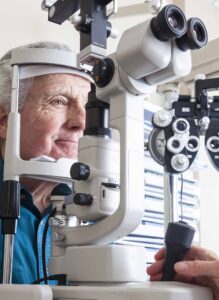 A medical screening might include the following:
- Visiting an optometrist or ophthalmologist and having visual acuity, peripheral vision, and contrast sensitivity annually tested as well as discussing night vision difficulty and increased glare sensitivity concerns.
- Getting a hearing test to determine any hearing loss limiting the ability to notice sirens, horns, or engine or other vehicle troubles.
- Evaluating motor and physical functions such as reaction time, range of motion, and strength. Arthritis, Parkinson’s disease, or a stroke can have a negative impact on ability to turn, steer, or brake.
- Conferring with a doctor about medications and side effects as well as their interactions with other drugs, supplements, and/or alcohol that may influence driving.
Driver evaluations
Many states require driving evaluations at or around age 70 that may include:
 A vision test.
- Written test assessing knowledge about road rules, traffic signs, and safe driving practices.
- Behind-the-wheel exam. Many states require this at specific age stages usually sometime beyond age 70.
- If a physician suspects memory or confusion issues, a cognitive screening may either be recommended or required.
 A vision test.
Vehicle modifications
There are some vehicle modifications for us older drivers that can help address vision, strength, mobility, reaction time, and other age-related issues. There are also some adaptions that drivers can do to their vehicles to reduce their risk of injury during a crash that are available through AARP’s CarFit program. Some possible modifications or some increasingly standard equipment include:
- Accelerator and braking hand controls to assist with reduced leg strength or foot control.
- Pedal extensions for shorter drivers that bring the accelerator and brake closer while keeping the driver a safe distance from the steering wheel and airbag.
- For drivers with arthritis, a weak grip, or are limited to one hand, spinner knobs or grips attached to the steering wheel allow the use of one hand to turn the steering wheel.
- Sturdy handle devices that can attach to the car doorframe to assist entering and exiting the vehicle.
- A seat that can rotate and extend out the vehicle allowing for easier entry and exit.
- For neck and shoulder stiffness, wide-angle and blind spot mirrors.
- Newer cars may have back-up cameras providing clear and real-time view of what is behind the vehicle
- Many newer vehicles have advanced driver assistance systems like adaptive cruise control, lane departure warnings sounds and haptics (i.e., physical feedback), and automatic emergency braking, and brake override which was designed to address pedal confusion.
- Some vehicles allow for voice-activated control functions for things like the radio, climate control, or navigation systems.
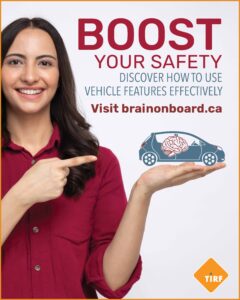 I do think it is unfortunate that car dealerships do not spend adequate time with a vehicle buyer helping to understand and use various advanced driver assistance systems. One resource which can help you understand how safety features work and what they do is at Brain on Board which is a TIRF education program about vehicle safety features.
And, do not be afraid to ask dealerships to review them with you before driving off the lot. The time to learn how your vehicle’s safety features work is definitely not in the middle of a crash event.
Planning for the next chapter of mobility

If we’re fortunate to live long enough to be an older driver, it is incumbent upon each of us to consider what determines when we are challenged or unable to drive safely. The good news is older drivers are less likely to engage in risky driving behaviours (e.g., speeding, driving aggressively, talking on a handheld telephone) than younger drivers. The bad news is even though we drive less and are more cautious, we are just as likely to die in a crash as a younger driver. This may be due, in part, to more fragile bodies. Nevertheless, it is essential that we are honest with ourselves about our ability to drive safely as we age. It is also true that we should be just as honest with family and friends who are older and driving. Mobility is also critical to overall health, so having a plan to drive safely as you age and to tap into other mobility options when it’s no longer safe to drive improves quality of life.
 Finally, we need to begin to plan for the day when driving is too difficult and dangerous. This may require understanding the availability of, and relying on, alternate transportation options such as Uber or Lyft, taxis, public transportation, senior ride share, and family and friends. This change will likely require some advanced planning before venturing out for needed or wanted items especially if they are in more than one location.
For all of you older drivers, I didn’t choose to write this blog to depress you (or me for that matter). I just felt this is a conversation we should have sooner than later because we should be old enough to know better.
#MySafeRoadHome blog author: Carl Wicklund, TIRF USA Senior Advisor, previously developed and managed several community-based programs for justice-involved individuals, served as Court Services Director for a three-county community corrections system, was for 20 years the Executive Director of the American Probation and Parole Association, and more recently was Director of the Community Justice Division of Volunteers of America – Minnesota/Wisconsin. He has been an active member of TIRF’s Working Group on DWI System Improvements since its inception in 2004.
Source documents and resources:
AARP Driver Safety. (2018, September 3). CarFit℠ Exam checklist. AARP. https://www.aarp.org/auto/driver-safety/carfit-exam-checklist/
Branch, Sophie, Espinosa, Nicole, McKinnon, Andrew C., Bennett, Joanne M. (2025, February). Transportation Research Part F: Traffic Psychology and Behaviour, Volume 109, February 2025, Pages 1523-1541
Cox, A. E., & Cicchino, J. B. (2021). Continued trends in older driver crash involvement rates in the United States: Data through 2017–2018. Journal of Safety Research, 77, 288–295.
Delavary, M., Lyon, C., Vanlaar, W.G.M., Robertson, R.D. (2024). Young and Aging Drivers. ESRA3 Thematic report Nr. 5. ESRA project (E-Survey of Road users’ Attitudes). (2024-R-22-EN). Traffic Injury Research Foundation. https://www.esranet.eu/storage/minisites/esra2023thematicreportno5youngandagingdrivers.pdf
Derafshi, R., Babulal, G.M. & Bayat, S. Impact of cognitive impairment on driving behaviour and route choices of older drivers: a real-world driving study. Sci Rep 14, 14174 (2024). https://doi.org/10.1038/s41598-024-63663-y
Hardwick RM, Forrence AD, Costello MG, Zackowski K, Haith AM. Age-related increases in reaction time result from slower preparation, not delayed initiation. J Neurophysiol. 2022 Sep 1;128(3):582-592. doi: 10.1152/jn.00072.2022. Epub 2022 Jul 13. PMID: 35829640; PMCID: PMC9423772.
Jorgensen MG, Paramanathan S, Ryg J, Masud T, Andersen S. Novel use of the Nintendo Wii board as a measure of reaction time: a study of reproducibility in older and younger adults. BMC Geriatr. 2015 Jul 10;15:80. doi: 10.1186/s12877-015-0080-6. PMID: 26155934; PMCID: PMC4496937.
Lococo, K. H., & Staplin, L. (2018). Visual scanning training for older drivers: A literature review (Report No. DOT HS 812 514). National Highway Traffic Safety Administration.
McNamara S, Jandu JS, Mohanaselvan A, et al. Cognitive Decline and Driving Evaluation in the Older Population. [Updated 2024 Oct 9]. In: StatPearls [Internet]. Treasure Island (FL): StatPearls Publishing; 2025 Jan-. Available from: https://www.ncbi.nlm.nih.gov/books/NBK569418/
Royal Society for the Prevention of Accidents Older Driver Self Assessment, https://www.olderdrivers.org.uk/driver-assessment/self-assessment/#:~:text=Do%20you%20suffer%20from%20a,to%20take%20your%20medication%20correctly?&text=Has%20the%20number%20of%20near,this%20website%20for%20further%20information
Staplin, L., Lococo, K., Mastromatto, T., Gish, K. W., Golembiewski, G., & Sifrit, K. J. (2019). Mild cognitive impairment and driving performance (Report No. DOT HS 812 577). National Highway Traffic Safety Administration.
Stutts, J. C., Martell, C., & Staplin, L. (2009, June). Identifying behaviors and situations associated with increased crash risk for older drivers (Report No. DOT HS 811 093). National Highway Traffic Safety Administration.
Weiner, E. (2014, March 14). IIHS puts backup cameras, parking sensors to the test. MotorTrend. https://www.motortrend.com/news/iihs-tests-backup-cameras-and-parking-sensors
Young MS, Bunce D. Driving into the sunset: supporting cognitive functioning in older drivers. J Aging Res. 2011;2011:918782. doi: 10.4061/2011/918782. Epub 2011 May 25. PMID: 21748014; PMCID: PMC3124981.