A TIRF Youth Advisor Program (TIRF YAP) blog.

TLDR: Driving shifts from anxiety-inducing at 16 to almost routine at 24. For many young drivers, as they acquire more driving experience and skill, at some point along the way distractions begin creeping in. What many fail to recognize is that confidence can be confused with skill making it more tempting to check a notification, a GPS map, or scroll at a red light. This temptation intensifies when friends or family do it too. The problem is distraction rarely shows up alone; it’s often accompanied with other risky behaviours. But, practicing simple habits that fit real life can help you fight temptation more so than rules or shame. So, set your music and GPS before you leave, turn on Do Not Disturb, keep your phone out of reach, and let passengers handle messages. Feeling confident doesn’t make multitasking (which is actually dual-tasking) safe… your attention matters to everyone else sharing the road with you.

Those first solo drives when caution comes 1st
I still remember my first year driving even eight years later. Hands gripping tight on the wheel. Music low or off. Don’t get me started on shoulder checks, signaling, and the dreaded merge lane. At 16-17, driving demanded all my attention because everything was so new. Learning how much pressure was needed when braking, checking mirrors constantly, scanning for street signs and pedestrians, and constantly replaying rules in your head. Every step was sequential and felt like they’d never become a single fluid motion. Each four-way stop and advance left turn felt like a test.
At this stage, most teens are gaining practice and accumulating mileage. So early on, risky behaviours are typically inhibited by a combination of Graduated Driver Licensing (GDL) restrictions as well as a healthy respect for the unfamiliar. Many new drivers are genuinely cautious because driving takes all their mental effort. This caution is protective. They don’t feel confident enough to introduce even the most basic task, like sipping coffee. And, honestly, this is a good thing.
It isn’t until teens accumulate a year or two of regular or almost daily driving that they become more comfortable and confident behind the wheel. So, they may not recognize their exposure to risk rises too, and they’re more likely to encounter the unexpected. This may take the form of a detour around a construction zone, an upgraded intersection, an ambulance or fire truck running lights and sirens, or wildlife appearing out of nowhere.
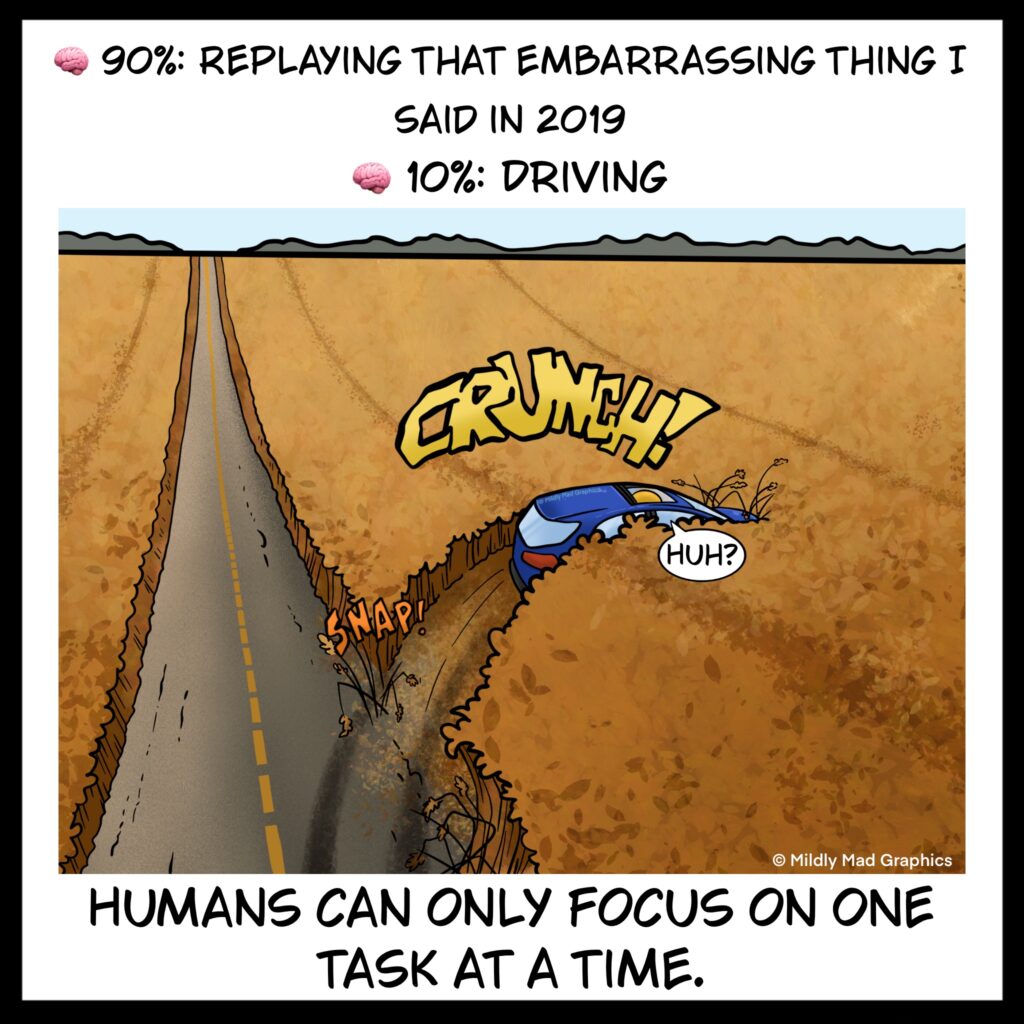
That’s the thing about driving…you can rely on the same routes every day but some days these unexpected events can catch you off guard. This is why distractions increase risk. The familiarity of driving can make you complacent and leave you unprepared to anticipate and react appropriately to potential hazards. What should concern all of us who share the road is that distracted driving among teen drivers is more prevalent than you might think. About one in five of even the youngest US teen drivers reported using a smartphone while driving in the past month. By 16-17 years old, this increased to more than one in three and by 18-20 years old, this was nearly one in two. Same roads. Same phone. Same risk. Just more time and confidence behind the wheel which can translate into a false perception of control and belief in their ability to engage in distracting activities, particularly if they haven’t been crash involved…yet.
What changes as teens become young adults
 Qualifying for full driving privileges changed something psychologically. I remember thinking, I’ve got this now. I’d been driving for a couple of years. I hadn’t crashed. Nothing bad had happened. That felt like proof I was a good driver and with a whole two years of experience, I was ready for anything…or so I thought.
The shift from late teens into your early twenties isn’t just about graduating, moving out, or getting a job. It is also about how you see yourself behind the wheel. Older teens are far more likely to think their friends are okay with phone use while driving because they may have actually seen at least some of those friends do it and/or no one speaks up when they do. By 18-20 years old, that perception builds and becomes normalized as part of your daily driving habits, which makes it harder to be the person who ignores those notifications at a red light. In other words, the familiarity of engaging with your phone and other distractions at the wheel reinforces the perception you can do it more frequently, particularly if you’ve never experienced a negative consequence.
There’s a fine line between confidence and overconfidence. The question young drivers have to ask is not whether they are confident they are a skilled driver, but instead, Are they confident no one else on the road will make a poor choice that creates a risk? they don’t see coming.

As someone who was crash-involved at 8 years old, I never had the luxury of having my beliefs being singularly shaped by my own skill as a driver. Before even getting my learner’s, I’d already survived the consequences of someone else making a poor choice, with life-altering consequences. As teens learn to drive, it’s essential they learn their safety is not entirely a function of their own choices. Every other road user is also out there making choices. Some will put you at risk while others will help keep you safe. As someone who now presents to teens about the consequences of distraction, a foundational message I share is that it’s more important to focus on self-preservation than right-of-way. Based on my experiences, my trust only goes so far. It’s rare to completely trust a random stranger, let alone those driving a 4,000lb vehicle (a.k.a. 1,800kg for those metrically-inclined). Confidence can be a good thing, but overconfidence can get you killed.
According to a survey of 1,200 teen drivers in the US, one of the main themes among drivers who reported using their phone was feeling confident, or very confident. Let’s be honest, driving is a responsibility not to be taken lightly. One of the lessons I took from my first few years of driving was that a LOT of things you don’t expect can happen on the road surprisingly often.
Believing 1-3 years of driving experience is adequate is like helping with a side dish and then thinking you can pull off an entire Thanksgiving feast. Some of the most astounding explanations for confidence included:
- Because I have so often…I’ve trained myself to be good at it I guess.
- I feel like I’m good at multi-tasking, and because when I get into situations like heavy traffic I put my phone up.
- Because I do it all the time so it’s not hard.
- I know it is very dangerous … and you aren’t doing it for long it should be somewhat safe.
There’s also the infamous, I have never been crash involved. Of course, assessing your driving skills based on whether you’ve been crash-involved entirely overlooks the fact that not only have roads and vehicles been designed to be more forgiving, but there are countless near-misses every day. The truth is, often the only thing preventing a near-miss from becoming a crash is a driver who was dialed-in; not distracted.
 While it might be a hard pill to swallow, one of the most important takeaways from the age comparison data was that older teen drivers are still pretty inexperienced behind the wheel. Two or even five years driving a vehicle can feel like a lot. In reality, some of the safest drivers on the road are in their forties, meaning they have at least two decades of driving not only on different roads and in different seasons, but also in different vehicles, emotional states, and environments. So, what teens need to remember is while they may feel like they are accumulating a lot of driving experience, the conditions under which they drive are still fairly limited. The variety of unexpected situations on the road can be endless from a family of ducks crossing to horrendous potholes to a large truck stalled in traffic to someone changing a tire on the side of the road to unsecured loads coming undone. A recent example of this was while I was following a pick-up truck turning left through an intersection when I noticed its load of tires and wheels was unsecured with the tailgate down and as he turned the load fell out on the road directly in front of me bouncing all over. Fortunately, I had left enough following room that I wasn’t hit by a rogue tire or wheel and had already scanned the area so was able to safely manoeuvre around the chaos. Remember, you have no control over the choices of other drivers on the road.
Crash risk doesn’t disappear simply because you feel more capable.
Most people don’t grab their phone at a red light because they plan to be unsafe, although intersections are one of the most dangerous places on the road. It usually comes down to two things: your friends seem fine with it, and you feel confident you can handle it. The truth is no one can.
Comfort starts to feel like skill
By your early twenties, driving is woven into daily life. Work commutes. Errands. Long, familiar routes. Comfort has quietly replaced caution.
 I noticed it for myself. Back then I didn’t feel distracted, I felt efficient. I knew the roads. I knew my car. I believed I could quickly adjust a playlist with one touch, follow GPS directions, and still be a good driver. Ask a teen in your life what feels dangerous while driving and they usually get the big ones right. Texting? Dangerous. Holding your phone? Also dangerous. That’s great. But looking closer at older teens and young adults, you’ll see a gap, one that widens as habits form and confidence grows. GPS, hands-free calls, loud music, quick checks at a light often get thrown into the not that risky category. Not because they’re harmless, but because they’re common and nothing bad has happened…yet. And, how you’re perceived by peers matters more. If everyone around you is doing it and nothing bad happens, the behaviour starts to feel normal.
The problem isn’t always what you’re doing. It’s how long your eyes leave the road or your mind wanders. Any task, texting, GPS, loud music, becomes dangerous when it steals your eyes and attention away, even for just a moment, from the task at hand, driving.
But confidence isn’t the same as competence. Comfort doesn’t mean you’re prepared for the unexpected; you just haven’t experienced it yet.
The emotional switch that actually works
 Here’s the opportunity to make a difference that could literally save lives. When young drivers were asked what would make them stop using their phone while driving, the strongest motivators weren’t fines or demerits. Despite a generational label of self-centered, we actually care more for others than even our own safety…the youth survey results support this as fact. The thought of seriously injuring or killing someone else cuts through the noise and motivates safer choices.
It shifts the question from Can I handle this? to What could this cost someone else? That kind of reframing matters, especially as drivers enter their early twenties.
Many young drivers are already making positive changes. Around half say they use Do Not Disturb, put their phone out of reach, or turn down loud music when it feels distracting. So, let’s not underestimate how much small changes can make a big impact.
Looking ahead
The journey from 16 to 24 isn’t just about improving driving skills, it is about freedom and identity, but also pressure. In just a few years, you transition from learner to fully licenced driver, but there are still many years of experience to go. It’s about learning where confidence helps, but also where it can quietly increase risk.
So, this is a simple pact that I use and could help you and your friends to set as early habits, and as you transition through all these phases of driving:
- Set the GPS before you go.
- Pick the playlist and stick with it.
- Turn on Do Not Disturb.
- Put the phone out of reach.
- Let your passenger be the copilot.
And remember what actually changes behaviour. Somewhere ahead is someone you may never meet but nonetheless they need you to keep your eyes up and fully engaged in the task of driving.
That person’s future is worth more than any text, call or other distraction.
 #MySafeRoadHome authors: Kylee Bowman, TIRF Lead, Youth Advisor Program (TIRF YAP) taps into the views, experiences and attitudes of young road users and helps TIRF develop educational strategies and communicate risks in ways that are relatable and engaging for young audiences. Kylee was crash-involved as an 8-year-old, and since 2011, she has been part of TIRF’s Drop It And Drive® (DIAD) education program. Robyn Robertson, TIRF President & CEO, collaborates with Kylee to blend the youth perspective with her background as a criminologist with 25 years of experience in road safety research. Robyn authored TIRF’s knowledge translation model and is well-versed in implementation strategies and operational practices across several sectors. Karen Bowman, Director, Communications & Programs (Drop It And Drive®) contributes her blogging background and experience leading the DIAD program since 2010. To date, the DIAD program has been delivered to over 65,000 youth and workers across North America.
Source documents & resources:
Asuako, P.A.G., Stojan, R., Bock, O. et al. Multitasking: does task-switching add to the effect of dual-tasking on everyday-like driving behavior?. Cogn. Research 10, 5 (2025). https://doi.org/10.1186/s41235-025-00611-y
Bowman, K., & Robertson, R. (2020, December). Keeping yourself safe when faced with distracted drivers on the road or in the workplace. Traffic Injury Research Foundation. https://tirf.ca/blog/keeping-yourself-safe-when-faced-with-distracted-drivers-on-the-road-or-in-the-workplace/
Delavary, M., Robertson, R. D., Barrett, H., Bowman, K., & Hamel, R. (2026, February). Teen smartphone use while driving: Age comparisons of risky behaviors, perceptions & attitudes (Youth Distracted Driving Survey). Traffic Injury Research Foundation USA, Inc.; produced for the National Distracted Driving Coalition.
Robertson, R. D., Delavary, M., Wicklund, C., & Bowman, K. (2025, April). Youth Distracted Driving Survey, National Results. Traffic Injury Research Foundation USA, Inc.; produced for the National Distracted Driving Coalition.
Traffic Injury Research Foundation. (2019, September). Hands-free technologies & driving [Infographic]. Drop It and Drive®.
Traffic Injury Research Foundation. (n.d.). GDL Framework Safety Center. https://gdlframework.tirf.ca/
Wicklund, C. (2025, December). Older drivers: We should be old enough to know better. Traffic Injury Research Foundation. https://tirf.ca/blog/older-drivers/